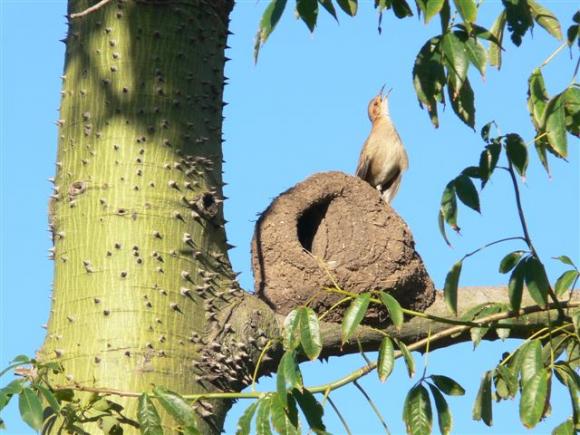
Rufous Hornero gives his brilliant song and shows his nest, on a Ceiba, Palermo Park, MArch 2011, with Philip
Rufous Hornero
The Rufous Hornero, Furnarius rufus, is a medium-sized Furnariidae from eastern South America, and the national bird in Argentina and Uruguay. Also known as the Red Ovenbird, it is common in savannas, second-growth scrub, pastures and agricultural land and is syanthropic (found near people). Its range includes southeastern and southern Brazil, Bolivia, Paraguay, Uruguay and northern and central Argentina (south to northern Patagonia). The species is most closely related to the Crested Hornero of Paraguay and Argentina. There are four accepted subspecies.
Overview
The Rufous Hornero is medium-sized with a square tail and very slightly decurved bill. The plumage is overall reddish brown with a dull brown crown and a whitish throat. Sexes are alike and juvenile birds are slightly paler below (probably because they are cleaner). Rufous Horneros feed on insects and other arthropods obtained by foraging on the ground while walking.They sometimes feed on human scraps, such as bread crumbs[1]. Songs in the Rufous Hornero are sexually distinct. The rapid trill that is usually heard as part of the duet is faster in the male, slower in the female, and both beat their wings at their sides while singing and the wings beat at the same rate as their trill. Thus, while watching an observer may identify the sex by how fast their wings beat while singing.
Predators of adult and young Rufous Horneros include birds of prey such as the Black Chested Buzzard Eagle Buteo melanoleucus[2], small mammals, domestic cats, and a number of species of snakes and possibly lizards[3]. However, its covered nest probably reduces predation risk.
The nest of the Rufous Hornero is a common sight in Brazil, Argentina and Uruguay
The Rufous Hornero breeds in the austral summer, laying eggs between August and December, raising nestlings soon after, and the young may stay in their natal territory until the following breeding season. The species is monogamous and the pair bond is long term, sometimes for life. The nest of the species is typical for the genus, a large thick clay ¨oven¨ placed on a tree, or man made structures such as fenceposts, telephone poles or buildings. Pairs remain together throughout the year and will work on the nest during that time; nests can be constructed in as little as 5 days but usually take longer, occasionally months, to complete. Between 2-4 eggs are laid (every other day) and incubated for 14–18 days. Chicks are fed for 23–26 days before fledging; young birds remain in the parental territory for around 6 months after fledging and sometimes until the following breeding season. Both parents incubate eggs and young and feed young. Horneros may or may not reuse nests, therefore it is quite common to see several nests close to each other (or even atop each other) at the same nesting area. However, a formerly unused nest can be repaired for a new breeding-season.
The Rufous Hornero has benefited from human changes to the environment and many live in highly modified habitat. Conversely, it can benefit various other species of birds, such as the Saffron Finch, who nest at its unused ¨ovens¨. It is a familiar sight over much of its range and has been adopted as the national bird of Argentina. It is not threatened by human activities and is listed as least concern by the IUCN.


 Por birdingbaires